Updated October 2026 · By the BGStraps team
Quick answer: to remove a Rolex bracelet, protect the lugs with tape, push a spring bar tool between the end link and the lug to compress the spring bar, and lift the bracelet away. Rolex generally doesn’t sell bracelets separately to the public, so most owners buy an aftermarket bracelet or strap in the correct 20mm or 21mm width instead.
Taking the bracelet off a Rolex is the step that puts most owners off changing straps at all. It looks like a job for a watchmaker, and done badly it leaves a scratch on the lugs that stays there forever. Done properly it takes about five minutes with one inexpensive tool. This guide walks through removing an Oyster or Jubilee bracelet and releasing a rubber or leather strap, then answers the question most people ask next: if the old bracelet is worn out, can you buy a new one from Rolex — and if not, what are the real options?

What you need
- A spring-bar tool with a forked end. A pushpin works in an emergency but slips more easily.
- A soft cloth or a microfibre mat to rest the watch on, face-down.
- Masking tape (optional but recommended) along the outside of the lugs to protect them if the tool slips.
- A tray or towel to catch spring bars. They are tiny and they travel.
Removing a Rolex bracelet step by step
- Lay the watch face-down on the cloth with the bracelet open and flat.
- Find the gap between the end link and the inside of the lug. That is where the forked end of the tool goes.
- Slide the fork onto the spring bar and press towards the centre of the case to compress it.
- While it is compressed, lift that side of the bracelet clear of the lug. The other side comes away easily once the first is free.
- Repeat on the second lug for the other half of the bracelet.
Work slowly and keep the tool parallel to the lugs. Most scratches happen because the tool is angled and slips outward across the case.
If your watch has drilled lugs
Some older Rolex references have small holes drilled through the outside of the lugs. If yours does, the job is far easier: push a thin pin straight into the hole to compress the spring bar, and lift the bracelet away. No tool ever touches the visible surfaces, so there is nothing to scratch. Modern references generally do not have drilled lugs, which is why the fork tool is needed.
Removing a rubber or leather strap
The mechanism is identical, but there is usually more room to work because the strap is softer than a steel end link. Bend the strap back slightly to expose the spring bar, compress one end, and lift it out. If the strap has quick-release pins, look for a small lever on the underside: slide it across with a fingernail and the strap lifts away with no tool at all.
Check these before you fit the new one
- Spring bar condition. They are consumables. If one is bent, corroded or slow to spring back, replace it rather than reusing it.
- Lug width. Most Rolex references take 20mm; the 41mm Submariner takes 21mm; Deepsea and Sea-Dweller references take 22mm. Our lug width guide by model lists them.
- End links. A rubber or steel band designed to sit flush needs end links shaped for your case. If yours are damaged or missing, we sell them separately in 20mm and 21mm.
- Clasp type. A Glidelock-style clasp lets you fine-tune the length without removing links, which matters more day to day than almost any other feature.
Fitting the replacement
Fit the spring bars into the new strap or bracelet first. Seat one end of the bar in its lug hole, compress the other end with the tool, and let it slide into place — you should feel or hear a small click. Then do the second half. Finally, pull firmly on both halves away from the case. A strap that is properly seated will not move. This last check takes two seconds and is the reason watches don’t fall off wrists. Once it is on, our guide on adjusting and sizing a Rolex bracelet covers getting the length right.
Can you buy a Rolex bracelet separately?
It is one of the most searched questions about the brand, and the answer surprises people: Rolex does not sell bracelets, straps or clasps as separate items to the public. If your bracelet is stretched, your strap is cracked or your clasp no longer closes properly, you have three realistic options — and only one of them is quick.
Option 1: through a Rolex service centre
An authorised service centre can replace a bracelet or strap as part of servicing your watch, and the part will be matched to your reference. This is the right route if you want the watch kept entirely original, particularly for a piece you intend to sell later or one still under warranty. The trade-offs are cost, waiting time, and the fact that the watch usually has to be left with them. Parts are fitted to your watch rather than sold over the counter.
Option 2: a used original bracelet
Original bracelets do circulate on the second-hand market. They keep the watch fully original, but there are two risks. The first is stretch: a used steel bracelet that has been worn for years develops play between the links, and that play cannot be reversed. The second is authenticity. Fakes are common at this end of the market, and a bracelet is much harder to authenticate than a watch. Buy only from a dealer who will take it back.
Option 3: an aftermarket bracelet or strap
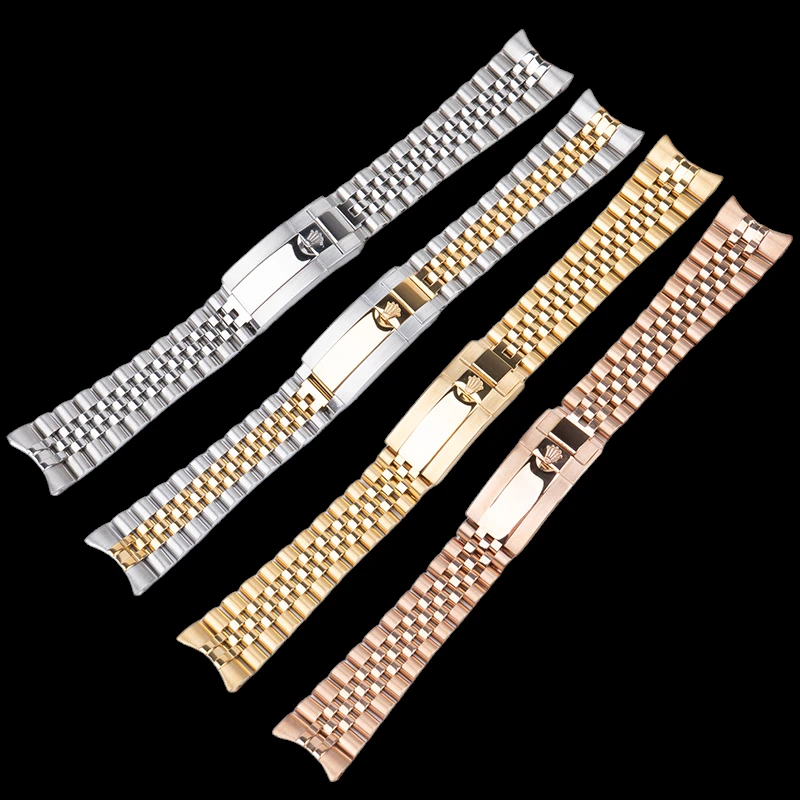
This is what most owners do for a watch they actually wear. A quality aftermarket band costs a fraction of the alternatives, arrives in days rather than weeks, and lets you change the character of the watch rather than just restore it. Our Rolex bracelets are built in 316L stainless steel with solid links and a Glidelock-style clasp, in both Oyster and Jubilee styles; there are also Oysterflex-style rubber straps and curved-end leather straps for the same cases. If the only problem is the fit rather than wear, a new clasp or set of end links may be all you need.
A note on originality and resale
If you plan to sell the watch, keep every original part, including the bracelet and its removed links. Collectors pay for complete, matching pieces. Wearing an aftermarket band in the meantime is entirely compatible with that: the original stays unworn in the box, and the watch you wear every day looks exactly how you want it to. Not sure which style to pick? Our Rolex bracelets and straps guide compares the Oyster, Jubilee, Oysterflex and leather side by side.
Swapping a rubber band rather than a metal bracelet? Our guide to replacing a Rolex Oysterflex band covers the end-link system step by step.
Frequently asked questions
How do you remove a Rolex bracelet?
Rest the watch face-down on a soft cloth, slide the forked end of a spring-bar tool into the gap between the end link and the lug, compress the spring bar towards the centre of the case, and lift that side of the bracelet free. Repeat on the other lug.
How do I open a Rolex watch band without scratching it?
Put a strip of masking tape along the outside of the lugs, work on a soft cloth, and keep the tool parallel to the lugs rather than angled. Most scratches come from the tool slipping outward across the case, and tape stops that from marking the steel.
Can I reuse the old spring bars?
Only if they are straight, clean and spring back sharply. Spring bars are inexpensive consumables, and a tired one is the most common reason a watch comes off the wrist unexpectedly. Replace anything bent or corroded.
Does Rolex sell bracelets separately?
No. Rolex does not sell bracelets, straps or clasps as standalone items to the public. An authorised service centre can fit a replacement to your watch, but parts are not sold over the counter. The alternatives are a used original bracelet or a quality aftermarket one.
How much does it cost to replace a Rolex band?
A replacement through a service centre is the most expensive route and usually means leaving the watch with them. A used original costs less but carries stretch and authenticity risk. An aftermarket bracelet or strap is the most affordable and the fastest, and it keeps your original safe in the box.
Does an aftermarket bracelet affect resale value?
Only if the original is missing. Keep the factory bracelet and its removed links in the box, sell the watch complete, and wearing an aftermarket band in the meantime costs you nothing — in fact it keeps the original free of wear.