IWC Schaffhausen has built its reputation on watches with genuine purpose. The Pilot’s Watches trace their design language back to cockpit instruments, the Aquatimer was engineered for divers, and the Portugieser began life as a marine chronometer for the wrist. These are watches meant to be worn hard and worn often — which is precisely why their straps wear out.
An IWC on a tired, cracked, or misshapen strap looks like a watch that’s been forgotten. Fit a fresh band and the same watch looks and feels new again, often for a fraction of what an original replacement costs. Better still, the right strap lets you shift the watch’s entire character: a Big Pilot on rubber is a different proposition to a Big Pilot on leather.
This guide covers what you need to know before you buy — the right size for your model, which material suits which watch, and one IWC-specific fitting quirk that catches a lot of owners out. You can browse everything that fits across our IWC strap collection.
Finding the Right Size for Your IWC
Every strap purchase starts with one number: lug width, the distance in millimetres between the inside faces of the two lugs where the strap meets the case. Get it wrong and the strap either wedges in or leaves gaps at the sides.
IWC’s range spans everything from compact 36mm dress watches to the imposing 46mm Big Pilot, so widths vary considerably across the collection. The figures below are the common starting points, but references differ even within a family — always measure your own watch before ordering. Our guide on how to measure your watch strap shows how to do it accurately with nothing more than a ruler.
Portugieser
The Portugieser is IWC’s most elegant line, and its larger case sizes carry proportionally generous strap widths. Portugieser models — including the Automatic and the Chronograph — commonly sit in the 20mm to 22mm range, with the bigger cases at the upper end. Because the Portugieser is a dress-leaning watch worn on a wide case, strap choice makes a dramatic difference to how formal it reads.
Pilot’s Watch
The Pilot’s family splits fairly clearly by size. The classic 40mm-class Pilot’s Watches, such as the Mark series, typically take around 20mm, while the Big Pilot at 46mm takes a substantially wider strap — commonly 22mm, and it needs that width to balance the case visually. A Big Pilot on an under-sized strap looks unmistakably wrong, so this is a model where measuring genuinely matters.
Aquatimer
The Aquatimer is IWC’s dive watch, built around a 42mm-class case that commonly takes a 22mm strap. As a true water watch, it’s the model in the range that benefits most obviously from rubber.
One Thing to Check First: IWC’s Quick-Change System
Here’s the IWC-specific detail that trips people up. Many modern IWC watches — the Aquatimer in particular, along with a number of recent Portugieser and Pilot’s references — use IWC’s proprietary EasX-CHANGE quick-change system rather than conventional spring bars.
On these watches the strap attaches via a bracket or push-button mechanism designed to let you swap bands by hand in seconds. It’s a genuinely excellent system, but it means a standard spring-bar strap of the correct width will not simply fit. You need either a strap made for that specific attachment system or the appropriate adapter.
So before you buy anything, turn your watch over and look at how the current strap attaches. If you can see a conventional spring bar spanning the lugs, you’re on a standard fitment and any correctly sized strap will work. If you see a bracket, a button, or a lever mechanism, you need a strap built for that system.
If you’re at all unsure which fitment your reference uses, check your exact model number before ordering — it’s a two-minute check that saves a return.
Choosing the Right Material
With size and fitment settled, the choice of material is where you decide what kind of watch you want to wear.
Leather: The Natural Fit for the Portugieser
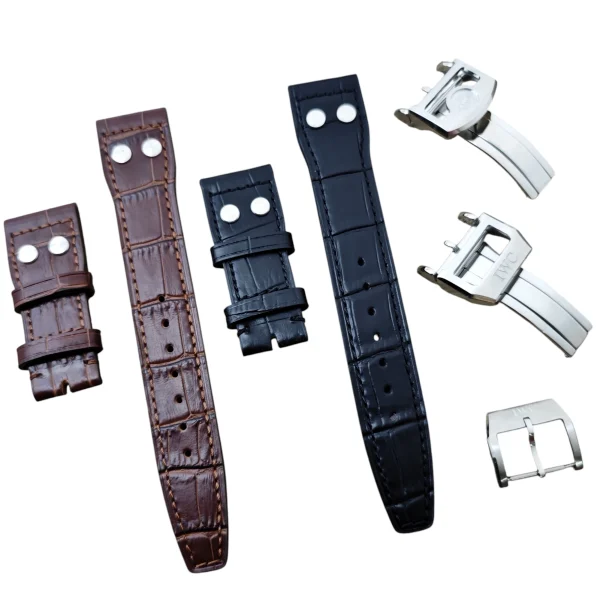
Leather is the classic pairing for the Portugieser and the traditional Pilot’s Watches. A stitched calfskin band brings warmth and formality, letting a large IWC sit comfortably under a cuff and read as a dress watch rather than an instrument.
Leather does ask for a little care — it dislikes prolonged water exposure and will develop a personal patina over time, which most owners come to value. For heritage-styled IWC references in particular, it’s difficult to improve on. Browse the options in our leather straps collection.
Rubber: Built for the Aquatimer
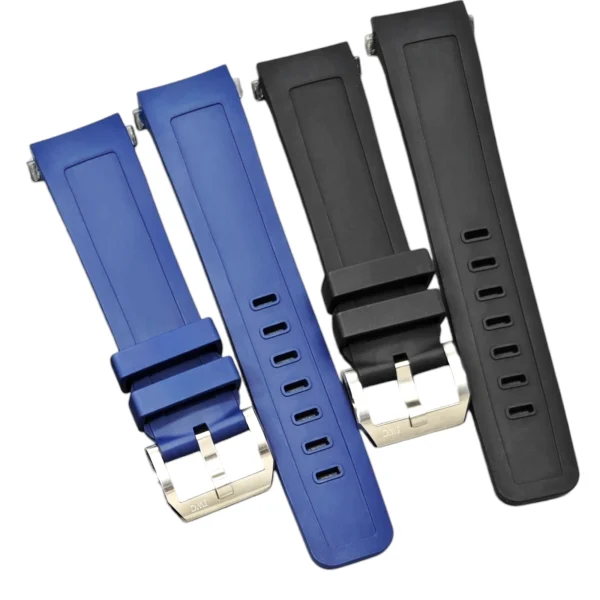
For the Aquatimer, or any IWC that sees water, heat, or heavy daily use, rubber is the practical answer. It’s fully waterproof, indifferent to sweat and sunscreen, and needs nothing more than a rinse to stay fresh.
Rubber also transforms a Big Pilot into a far more wearable everyday watch, taming its formality without losing its presence. If you’re deciding between rubber types, our guide to FKM vs. silicone straps explains which suits diving and hard use versus everyday comfort. The full range is in our rubber straps collection.
Canvas: The Pilot’s Watch Character
Canvas suits the Pilot’s line almost too well. Its utilitarian texture echoes the military heritage the design draws from, and it’s breathable and comfortable in warm weather. For a Pilot’s Watch you actually knock about in, it’s a compelling and characterful choice — see our canvas straps.
Steel Bracelets: Weight and Versatility
A stainless steel bracelet gives an IWC substantial wrist presence and moves easily between casual and formal settings. It’s the most durable option of all and needs essentially no maintenance. Have a look at our stainless steel bracelets to match the finish to your watch.
Fitting Your New IWC Strap
On standard spring-bar fitments, changing an IWC strap takes about ten minutes.
Lay the watch face-down on a soft cloth to protect the case. Using a proper spring bar tool, slide the forked end between the strap and the lug, catch the shoulder of the spring bar and compress it inward until that side releases, then lift the strap away. Fit the new strap by seating one end of the bar in its lug hole, compressing the other end, and guiding it into place until it clicks. Finally, tug both sides firmly to confirm both bars are locked.
Take your time and use the right tool — a slipped screwdriver leaves a permanent mark on a polished lug. If you’d like a fuller account of the risks and how to avoid them, our guide on whether aftermarket straps are safe for luxury watches covers fitting, warranty, and resale in detail.
On quick-change fitments, there’s no tool required at all — release the mechanism by hand, lift the old strap clear, and click the new one into place.
Give Your IWC a Second Life
An IWC is engineered to last decades, and the strap is the one component designed to be renewed along the way. Measure your lug width, confirm whether your reference uses spring bars or IWC’s quick-change system, then choose the material that matches how you actually wear the watch — leather for the Portugieser’s elegance, rubber for the Aquatimer’s element, canvas for the Pilot’s rugged character, steel for everyday versatility.
Explore our full IWC replacement strap collection and find the band your watch deserves.